Topics

Sunday, April 16, 2017

¢ Mothercents ¢ Why and How Mending is Better than Ending

A reminder to appreciate
the ties that bind

Image Credit: John Shepherd
"Ending is better than mending." This quote from Brave New World came back to me in a flood of memories.  This novel introduced me to the twisted world of dystopia.

This world conceives children in test tubes with varying amounts of alcohol to determine their social class.  The word father is a joke, and mother is an obscenity. A world devoid of motherwit reaches the short-sighted conclusion: Ending is better than mending.

The last several posts have focused on taking care of things to save money. Let's refocus now on why we take the trouble to save.  We live in a throwaway society.  Cheap goods tempt us to replace rather than repair. Why not throw in the towel?

When our mentality shifts to one of disposal for convenience instead of necessity, we toss out our past, present, and future.

1. We lose maintenance/repair skills passed through generations.   

2. We lose out on developing creative, problem-solving skills in the present - including re-purposing. 

3. We lose out on the planet  if we cultivate landfills and incinerators instead of sustainability.  

Ecology is a logically sound reason, but not even the best one. When we repair, recycle, re-purpose or donate, we not only invest in a healthy planet.  We open our eyes to the intrinsic value of everything.

As we place higher value on goods, our own value as human beings should also appreciate.  As we invest in our priceless innovation, we realize our capacity to grow and learn.

Sifting Wheat from Chaff

Granted, the trash cash has its place.  However, is the garbage our first or last resort?  Asking ourselves the following questions can help us distinguish trash from goods with some further purpose.

1. Has this product become unhealthy or dangerous?  Food and medicines past expiration dates put your health at risk.  In these cases, go on to question 2.

2. Can I dispose of this product more safely or sustainably?  Stale or spoiled food can compost into fertilizer for the lawn and garden.  Local police stations sponsor safe drug disposal days, and some pharmacies offer to dispose of expired medications.

3. Can anyone else benefit from this product?  Goodwill Industries and other thrift shops accept donations of clothes, shoes, DVDs, CDs, household goods, books and toys, to name a few.  Goodwill can even use clothes in poor condition to make rag rugs. General thrift store guidelines can put you in the ball park, but checking with specific organizations is recommended.

Freecycle groups post items to swap and save everyone money.  Check out the Freecycle link for background information and groups near you.

Developing a Mending Mentality

Before we can destroy anything, we must see it as either worthless or hazardous.  However, a mending mentality require us to see value in ordinary things in their appropriate places.  Mending challenges us to look beyond exteriors into essential characteristics.  Food waste can break down into compost.  The plastic net bag that held oranges can consolidate garden tools and even allow them to drip-dry.

In this throwaway world, a mending mentality requires consistent practice and pooling knowledge.  We welcome your feedback and ideas here.  Please, don't be shy, and leave your suggestions in the comments section.


Monday, April 10, 2017

¢ Mothercents ¢ - Laugh and Learn from Soaking, Simmering and Salvaging Beans

When Mistakes are the Mother of Invention

Not checking the chart
for soaking and cooking
 led to mushy beans.
Laughter is the valve on the pressure cooker of life.  Either you laugh and suffer, or you got your beans or brains on the ceiling.     - Wavy Gravy 

These wise words echo my feelings on an overcooked pot of black eyed peas. I know that checking the bean soaking/cooking chart leads to a more delectable dish, but still I skipped the step.

I fell into the seductive trap of "multi-tasking."  While I pored my attention into cookie baking, the peas dissolved into mush. Yes, sometimes multi-tasking is an inevitability.  When we upgrade it from necessity to virtue, we may set ourselves up for disappointment.

Properly boiled black eyed
peas keep their shape.

Image Credit: George Kelly
Motherwit, I am learning, is as much about salvaging messes as preventing them.  Fortunately,  mushy beans slip nicely into my salads where shapes, textures, and colors compensate for flawed peas. More importantly, mistakes can lead to discovery.

Another cook online boiled peas too long and posed the question on Veggie Boards: How can we use overcooked black query on what to do with overcooked peas?  A flurry of overcooked black-eyed pea suggestions ranged from pates to fritters. Would the cook have opened the door to those possibilities without the mistake?

Cooking beans yourself can not only save money.  It put us back in charge of what we eat.  Even errors can lead to possibilities, as we unpack in this week's Mothercents.

For Best Results - Or Making the Best of Your Results

1. Check the Chart
Most cooks try for the best possible results, and planning is the key.  Amanda Meyers has shared a complete bean soaking/cooking chart. Wikihow also offers step-by-step guide to cooking beans on the stove or in a pressure cooker. I would only add three tips to reduce gas and digestive discomfort.
  • Soak the beans in baking soda. 
  • Cook beans with a bay leaf.
    The left pea is falling apart
    while the right one stays firm.
  • Let beans reach a boil for a few minutes, and then let them simmer.  

Properly cooked beans should hold their shape in the hand but mash easily between your fingers. The photo illustrates the difference, with the ideal bean on the right. If your end result resembles the left one, read on.


2. Making the Best of Bedraggled Beans 

Salads can hide a multitude of mistakes, but a wealth overcooked black eyed pea suggestions await on Veggie Boards.  Rather than repeat the ideas, I'll highlight some yummy options.
  • Hummus: Mix them into a hummus with or even replacing garbanzo beans.  Mushiness is an asset in the blenders.
  • Pate: Experiment with a simple black eyed pea and pecan pate or a more challenging black eyed pea pate.  Great on crackers for a party.
  • Fritters:  Black eyed pea fritters or spicy African Accara capitalize on moisture to mix well with other ingredients.
  • A salad can mask misshapen peas, although
    I'd rather not serve it to company. 
  • Croquettes:  Add some quinoa and make this crispy on the outside, chewy on the inside treat from Vegan with a Vengeance.

Laughing and Learning

When we can make the best of whatever life brings, we grow. When we can laugh at our imperfect products, we reconnect with what makes us human.  Not one of us can play the hero or the clown all the time.  We need both to round us out as people.

Feeling trapped in mistakes chokes the chuckles right out of me.
Laughter comes easier to me when I see more possibilities, more choices.  So how about you?  How do you get your best results?  When life hands you lemons, how do you make lemonade?  Write us about it in the comments, and keep the conversation going.


Monday, April 3, 2017

¢Mothercents¢ Save What Truly Matters When Out of Power

What Truly Has Value

Motherwit moments can strike at a moment's notice.  An ordinary occurrence reveals an extraordinary lesson.  An unexpected event teaches us what we value most.  Last week, Motherwit struck when a
The Emperor in "The Nightingale" 
Image Credit: Creative Commons
stray car blocks away from my house crashed into a pole.

The driver brought down the power lines and brought on a short power outage. The two hours of darkness taught my niece new skills and instilled a deeper appreciation for what truly matters.

Cozily curled up on the couch, my mom, niece and I were enjoying hot pizza and Faerie Tale Theatre. The episode of Hans Christian Anderson's "The Nightingale" had captivated my niece, Sophia, who loves anything related to China.

The story tells of an extraordinary friendship between a great, Chinese emperor and a simple nightingale.  Even after the emperor rejects the nightingale, the little bird returns to him on his deathbed and saves his life.

When the emperor had lost his power, he discovered what mattered most.  He knew then what to preserve, and what to let go. Ironically, the outage also taught us what to save and what to use up.

What can we discover in the nightingale's song?
Image Credit: Kev Chapman

Life Lessons and Practical Magic

The emperor discovered that the nightingale's loyalty meant more than all his imperial splendor and power. Similarly, Sophia discovered that problem-solving, creativity, and love mean more than electricity and even an excellent DVD.

In all her ten years, Sophia had never experienced a power outage.  Snuggling in blankets, we told stories and watched my seven-month-old kitten gaze upon the gas log fire. Grandma and Sophia took a walk to see how far the power outage extended. The power came on seconds before they returned.

My mother and I gathered flashlights, lit the fireplace, and safeguarded food in the refrigerator and freezer. Sophia longed to finish the show, but she got into the pioneer spirit, carrying candles, winding up the human-powered flashlight, and watching the fireplace. She regarded each emergency measure as as a piece of practical magic and the outage as a new adventure.

Sophia later told her mother how we kept the refrigerator cold.  We moved frozen half-gallon containers of ice from freezer to refrigerator. The refrigerator then functions like an icebox until power returns.  This adventure leads to this week's tips on preserving food in an outage. Even when power outages limit your options, you can choose one of these ideas.

¢Mothercents¢ Preventing Waste in a Power Outage

Half gallon milk jugs
 stand and freeze well.
1. Freeze emergency ice packs.
Plastic half gallon milk or juice containers make excellent emergency cooling agents.  Wash them out and fill them with clean water, but leave two inches empty at the top to allow room for freezing.  In an emergency, use them to cool perishable food in the freezer, refrigerator, or cooler.

* Experiment with smaller bottles with tight caps as ice packs for injuries.  Ice can stop swelling and pain very effectively.

2. Use porches, balconies, garages, basements or cooler rooms.
If you have one of the above, you may have an extra refrigerator or even freezer in cold weather.  I once weathered a three-day power outage without food spoilage, simply because we moved perishables to an unheated porch in a chilly November. 
They store well on my top shelf.

3. Eat what you can't save.
My mom, Sophia, and I treated ourselves to big bowls of ice cream in front of the fireplace.  When you're unsure that you can outlast an outage, use up the most perishable items first.  

Knowing power outage safety empowers us at a time when we have no power.

Motherwit Moments 

Not all discoveries comes with fanfare and fireworks.  More often, we learn priceless wisdom in small epiphanies.  If we pay attention, we can find the extraordinary in rather ordinary circumstances - a power outage, making dinner, or a sunset.  

What extraordinary tidbits have you discovered in an ordinary moments?  Please share these moments in the Comments section.  


Monday, March 27, 2017

¢Mothercents Mondays¢ Dried Garlic or Hot Pepper Keep Bugs out of Rice


Image credit:  Ume-y
In late March, the Japanese cherry blossoms reach their peak of beauty. They elicit memories of my two and a half eye-opening years in Japan.

I met wonderful people who taught me far more about life than the English I taught them.  Intelligent, determined women filled my classes and passed along bits of motherwit to me.

Roots of Motherwit

The Japanese Goddess, Amaterasu
Image Credit:  Wikimedia
Japanese motherwit may extend all the way back to its mother deity. Their native religion, Shinto, teaches that Japanese emperors and nobility all descend from their sun goddess, Amaterasu.  Her light blesses earth with life and prosperity to the all the earth, especially Japan.

Japanese history also praises motherwit.  Kazutoyo Yamanouchi,  a sixteenth-century samurai, bemoaned lacking the money to buy a fine warhorse. His wife, Chiyo, amazed him by handing him the very sum he needed. He bought the horse and won the battle.  Japanese women cite this story as proof of their budgeting skills.

So how do Japanese save money?  They take care of everything, starting with the staple of rice.  When homemakers open a fresh bag of rice, they add either a garlic clove or a dried hot pepper.  Either one repels larva and bugs.  Preserving the main source of food prevents the unsavory discovery of buggy rice, and in so doing, unnecessary waste.


Common Questions

Aren't airtight containers enough to prevent infestation? I used to rely solely on Rubbermaid. However, the humid Japanese climate fostered more bug than I care to remember, some of which finagled their way into my rice.  My students came to my aid with this tip, and I haven't had problems ever since.

Image Credit: Ruocaled
Will the garlic or hot pepper affect the rice's flavor? Garlic and hot peppers need water to release their flavor into dry foods. Check the garlic clove for freshness.  Cut open a clove to check for moisture and smell.  If the clove has both, the whole bulb is viable.

Do not insert the opened clove in rice.  Instead, add an unopened clove from the same bulb.  The moisture within keeps the smell on bugs' radar, but will not flavor the rice.

How About You?

Everyone has wisdom to share, either learned from another or something you've discovered yourself.  Please share your ideas about money management or taking care of things. Write them in in the comments below so that we can all share these tips.  Motherwit is always evolving and expanding.  Your discoveries are an important contribution to its survival.

Monday, March 20, 2017

¢ Mothercents ¢ Defrost Food in the Refrigerator to Save Energy

Find out how to get your money's worth
from frozen foods.
Image Credit: Stephen Depolo 
As news sources report the bleakest outlook on climate change, I'm determined to save energy as well as money.  Despite my good intentions, I often miss the mark.

Just this Saturday, I could have kicked myself.  I knew that I would need to thaw frozen tempeh to make my vegan sausage balls.  


I had planned a batch-cooking extravaganza for a week, yet I neglected to defrost the main ingredient in the money-and energy-saving, motherwit way. 

Fortunately, I could simply steam it without fear of dangerous microorganisms multiplying. The missed opportunity inspired me to include this tip in this Monday's ¢Mothercents¢. 

Most cooks prefer one defrosting method over another.  Depending on a food's size or volume, foods can safely thaw in the refrigerator, cold water, the microwave or the cooking process. For more details, see the USDA Defrosting Guidelines.

However, to save both money and energy, defrosting in the refrigerator is the way to go.  To understand why, consider how a refrigerator works.  Consider how it can work to your advantage.  

Refrigerator Basics 

For simplicity's sake, I will explain how the compressor works together with the thermostat to keep food cold. For more complete information, feel free to check out how a refrigerator works. 

Work with your refrigerator to save money and energy
Image Credit: Osseous
The compressor pumps coolant throughout the refrigerator to maintain even coolness. However, the compressor needs the thermostat to signal when the temperature creeps too high.  When the thermostat has nothing to report, the compressor takes a break.  

Defrosting in the fridge introduces a new source of coldness.  As long as the thermostat senses the temperature below the limit, it doesn't send a request to the compressor.  Effectively, owners can recoup the money spent on energy for the freezer by utilizing it in the refrigerator.

Open Forum on Money-Saving Tips 
This blog will continue sharing ways to stretch money, but I am by no means the only source. What motherwit tips do you have to share?  Feel free to write in comments or questions in the comments.  Sharing motherwit enriches us all and builds community, so join in the conversation!

Sunday, March 5, 2017

¢ Mothercents Monday ¢ - Freeze flour for an extra year of freshness.

My lifelong friend Angela has magic that whips up meals from odds and ends - or makes baking mix last up to a year longer.

Her magic came in handy when she worked as a head chef at a shelter.  She cooked for over one hundred people a day. Stretch her resources to keep serving healthy meals came with the territory.

One day, a fairy-godmother donor dropped off a superfluity of boxed baking mixes.  Angela knew that they wouldn't all keep in the pantry, so she moved them all to the walk-in freezer.  After a 24-hour debugging freeze, she could take out a couple at a time to use.
Image Credit: CCO Public Domain

Likewise, our freezers can extend the life of our flour and/or baking mixes.  Cooks who use up flour long before expiration can skip this step. Sporadic bakers like myself can benefit.

This flour storage guide provides details on freshness for various types of flour. They advise freezing in plastic bags, especially for open sacks of flour.

Unopened packages may not need this precaution, although it may keep ice and moisture at bay.

Friday, March 3, 2017

¢ Mothercents Mondays ¢

Image Credit: Stevepb
Our reader Serena commented that listening to motherwit can carry traditions and heritage into the present. Investigating motherwit can also invest in ourselves and our futures.

Money management requires careful planning and a lifetime of practice. We will unpack the general principles gradually, but like the staircase, every journey begins with a single step.

Fortunately, many moms can slice their budget tips into bite-size bits. Join us every Monday for our theme day: Mothercents Monday.  You can put these simple steps right into place to prevent waste and save money.  Please feel free to give feedback and suggestions in our comments.


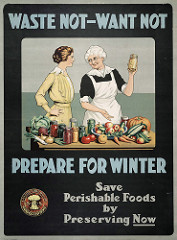
Waste Not, Want Not
Image Credit: Special Collections Toronto
This World War I Canada Food Board poster promoted food preservation. One hundred years later, the same principles of
thrift can benefit us rather than a war effort.  We can start by preventing bug infestations of staples in our cupboards right now.

Mothercents Tip 1: 

Freeze your flour. My friend Angela learned this trick to kill larva from her home-economics teacher and mother. Neither Angela nor her mother ever loses flour to bugs at this critical stage, although Wikihow recommends freezing flour up to four days.

When you bring home a new sack of flour from the store, stick it into the freezer for at least twenty-four hours.  You may move it to standard storage after the deep freeze kills any larva which may have unfortunately entered flour in the grinding process.

Please invoke your own motherwit and tell us about it.